Saltwater or chlorine: which pool suits a Hawaii home?
A saltwater pool still runs on chlorine, so the real question is how you want to make it and what your yard can live with.
October 16, 2026 · 4 min read
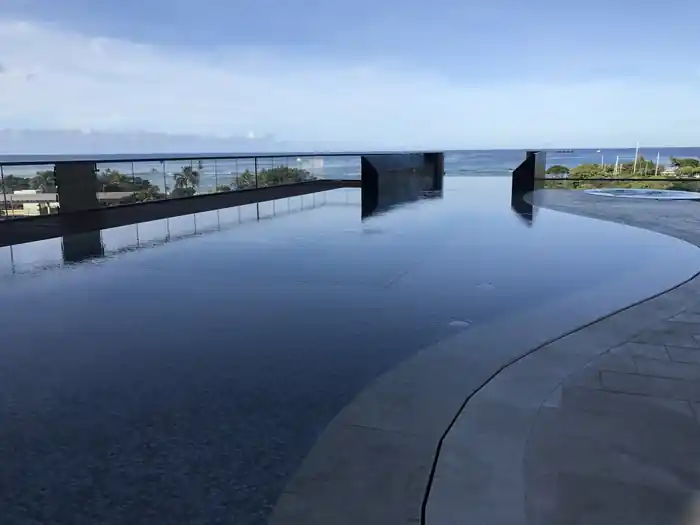
Ask ten pool owners on Oahu whether saltwater or chlorine is better and you'll get ten confident answers, most of them describing whatever pool the person happens to own. Here's the part that gets lost: a saltwater pool is a chlorine pool. The difference is where the chlorine comes from, and that changes what you do each week, what wears out, and how the water feels on a slow Kona day when you're floating and not thinking about any of it.
What a saltwater pool actually does
A saltwater system puts a salt cell in the plumbing. As water passes over the cell's plates, an electric current turns dissolved salt into chlorine, which sanitises the pool and then breaks back down into salt. The salt level is a small fraction of the ocean's, so the water doesn't taste briny. You aren't skipping chlorine. You're making it at the equipment pad instead of carrying it in from the store.
A conventional chlorine pool is dosed directly, with liquid, tablets or granules, added by hand or through a feeder. You buy the chlorine, you control the amount, and there's no cell to look after.
Where saltwater earns its place
- Steadier chlorine. The cell produces a little all day, so the level doesn't swing between a heavy dose and a thin one.
- Less handling. Fewer jugs and buckets to store, and fewer trips to the shop.
- Water that many swimmers describe as softer, with less of the sharp chlorine smell.
- Easy to run from a timer or an automation system, which suits a home that sits empty for part of the month.
Where chlorine earns its place
A chlorine pool is simpler equipment. There's no cell to scale up and no cell to replace, and you can raise the chlorine fast after a storm or a party without waiting for a generator to catch up. If the property is a rental, or the pool sits under a lot of leafy trees, that quick correction is useful. The tradeoff is that someone has to keep dosing it, and weekly is the rhythm that works.
Hawaii changes the conversation
Three local things matter more here than they do in a brochure.
First, the sun. Ultraviolet light burns chlorine out of the water quickly, which is why both kinds of pool need a stabiliser (cyanuric acid) to protect it. Too little and your chlorine is gone by mid-afternoon. Too much and the chlorine works poorly. A saltwater pool doesn't escape this. Its cell is still making chlorine that the sun will chew through.
Second, the rain. A hard shower rolling off the Koolaus, or a few days of Kona weather, dilutes everything: salt, stabiliser, alkalinity. In a saltwater pool a drop in salt means the cell makes less chlorine just when runoff and debris are adding demand. After a big storm, test the water before you assume the system caught up.
Third, the salt itself. Salty water plus salty air is a lot of salt around natural stone, metal fittings and equipment. A pool with rock waterfalls, stone coping or stainless hardware deserves a conversation before you commit: which stone, how it's sealed, what the equipment is made of. It's the biggest reason we ask about the whole yard, not just the water, before recommending a system.
What about cost?
In general, saltwater costs more to set up and less to feed week to week, and the cell is a part that eventually has to be replaced. Chlorine flips that: cheaper to start, steady spending on product. Which one comes out ahead depends on the size of the pool, how warm it runs and how much sun it sees. Ask for a quote that includes the equipment, not just the sanitiser, so you're comparing like with like.
Can you switch later?
Often, yes. A salt cell can usually be added to an existing pool, though the finish, the equipment and any natural stone should be checked first, since salt finds the weakest material in the system. Going back to chlorine is easy: you stop the cell and start dosing.
So which suits a Hawaii home?
If the house is lived in, the pool gets used most days and you want steady water without handling chemicals, saltwater is a comfortable fit. If the property is a rental, the pool is shaded and leafy, or it has a lot of stone you'd rather not expose to salt, chlorine is a perfectly good answer. Neither is the wrong choice. The wrong choice is a pool nobody tests.
Pacific AquaScapes has been building and servicing pools since 1980, and we service both saltwater and chlorine pools. Bring a water sample to our Kapolei store at 2254 Lauwiliwili St and we'll test it free on a Spin Lab Waterlink photometer, whichever sanitiser you run. If you're planning a new pool and want the sanitiser decided alongside the design, start with our pool design and construction page at /services/pool-design-and-construction. For weekly care of an existing pool, see /services/pool-maintenance, or call (808) 682-1020.
Pacific AquaScapes, (808) 682-1020
Call (808) 682-1020More articles
Common mistakes when hiring a pool contractor in Honolulu
Most pool regrets trace back to how the contractor was chosen, not how the concrete was poured.
Design ideas for a new pool in Honolulu
The best island pools start with the yard, the wind and the view, and only then with the shape of the water.